
A week in Lapland
2026-10-26
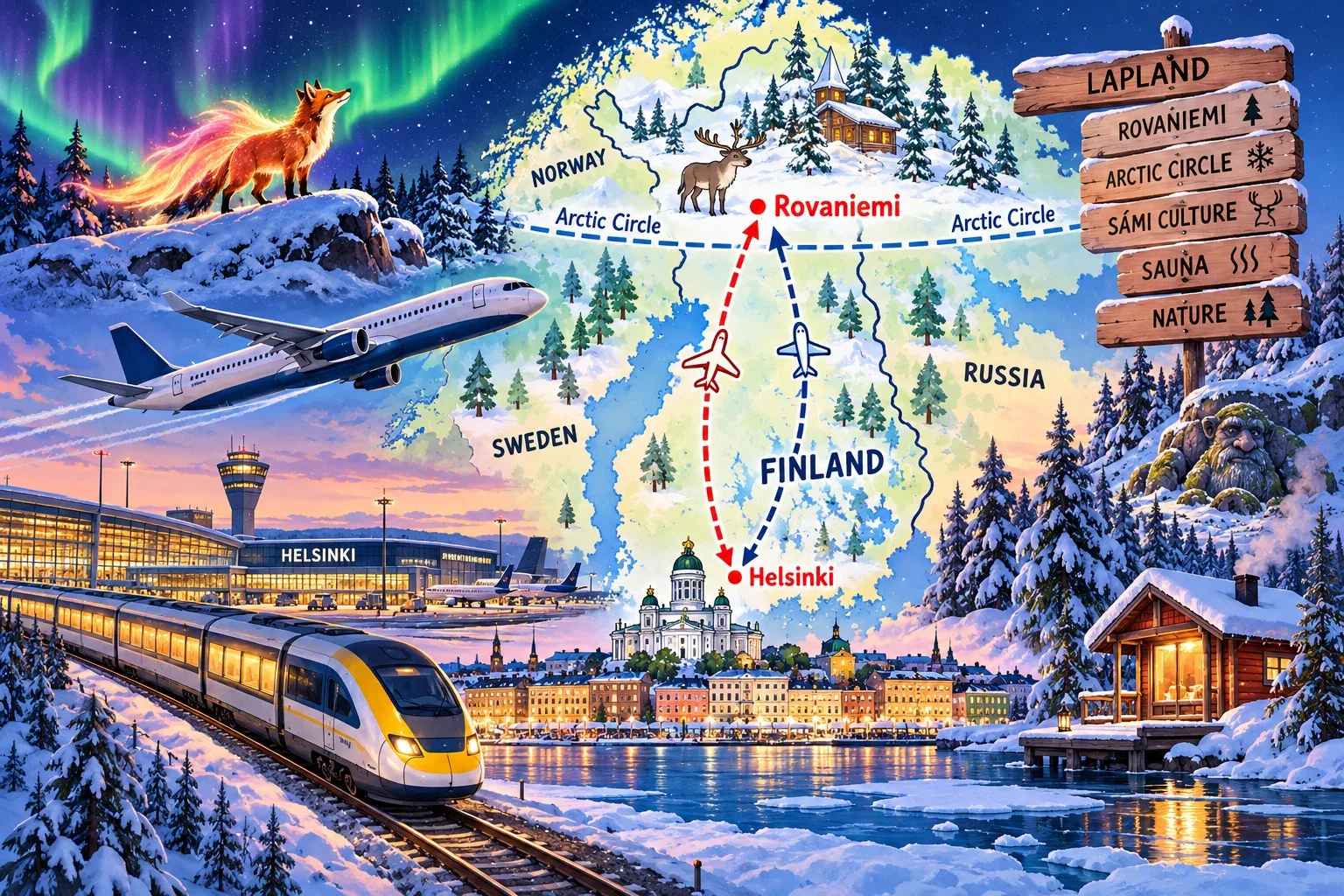
On 25 October 2026 we took the train to the airport, to spend a night at a hotel before our flight to Rovaniemi, in Finnish Lapland. We had a map open in front of us, and this is the story I told my son on the way. The science and the dates are real; the trolls, the elves and the fox are legends, and Sisu is all ours.
Have another really good look at this map we’ve got open in front of us. See that dashed blue line cutting across it, almost at the top? That’s the Arctic Circle. Tonight we sleep near the airport, tomorrow we fly north, and this week we’re going to cross it. This trip isn’t just another holiday adventure where we take a few nice photos: it’s an expedition to one of the most fascinating corners of the Earth, where geography, science, ancient legends and even our own family’s story meet in the middle of the ice.
The call of Sámi blood
There’s a very special reason this trip means so much to us. When your mum and your grandmother Lice looked into the family’s deep genetic roots, they found a surprise from many centuries ago: there’s Sámi blood in their veins, and so that same blood runs in you.
The Sámi are the only recognised Indigenous people in the European Union. Long before Finland, Sweden, Norway or Russia drew their borders on the map, this northern land was called Sápmi. It was a land without fences or customs posts. For thousands of years, your ancestors learnt to survive in a place where nature is in charge. They didn’t see winter as an enemy, but as a home. They were nomads who followed the great reindeer routes, built cone-shaped tents called lavvu, and treated every mountain and every ancient boulder as a sacred place, a sieidi.
The Sámi have their own way of telling stories: the joik. A joik isn’t an ordinary song with verses and rhymes: it’s a melody of the voice that tries to capture the essence of something. You don’t sing about a reindeer, a mountain or a person; you sing the reindeer, the mountain or the person itself. So when your boots first touch the ground in Lapland, remember that a very distant part of who you are is coming back to a place where your ancestors sang to the wind and the ice.
The invisible border and the sun of 1 November
So what does it actually mean to be above the Arctic Circle? At school we learn the lines on the globe, but out there it’s a magic line drawn by the tilt of our planet. Being above the Arctic Circle means being in the part of the world where, at the summer solstice in June, the sun doesn’t set for twenty-four hours (the famous midnight sun), and where, at the winter solstice in December, the sun doesn’t rise above the horizon, in a bluish, mysterious season the Finns call kaamos, the polar night.
When we land tomorrow, it’ll be the end of October, right on November’s doorstep. And do you want to hear a scientist’s detail about the light we’ll get at that latitude? On 1 November, when we’re back in Rovaniemi, the sun will rise at about 8:15 in the morning and set at about 3:45 in the afternoon. That’s only about seven and a half hours of daylight. But the most amazing part is this: because the sun stays so low in the sky, it never climbs high over our heads; it keeps gliding along the horizon, making a golden light that goes on and on, like a sunset that lasts all afternoon. And every day that passes, Lapland loses more than seven minutes of light to the winter dark. We’ll be watching that race against the polar night as it happens.
Vikings, forests and a language from far away
When we think of Scandinavia, we think of the Vikings straight away. And it’s true: in Norway and Sweden, Viking warriors and sailors built long ships with dragon heads carved in the wood, worshipped Odin and Thor, and set off across wild seas to conquer the world. They sailed along the coast of Finland too, to trade furs or fight battles, but the Finnish land was a mystery of its own.
The Finns weren’t Vikings. While the languages of Sweden, Norway and Denmark are sisters in the same Germanic family, Finnish belongs to a completely different tree: the Finno-Ugric family. It has nothing to do with Swedish, or English, or Portuguese! It’s a language born in deep forests and the bogs of the taiga, related to Estonian, to the languages of the Sámi themselves and, distantly, to Hungarian. For hundreds of years Sweden ruled Finland (and that’s the historical reason almost everything in Finland is still written in two official languages, Finnish and Swedish), before the country passed into the hands of the Russian tsars. But the Finnish people always kept their own identity, like pine roots gripping granite.
The strength of Sisu, the stubborn guardian
To explain how these people kept their soul and won their independence in 1917, we need to talk about a very special strength. In their language the word is sisu, and we’re going to treat it as a name, as Sisu, a she! It’s much more fun that way, and it reminds us of Sisu, the dragon in Raya and the Last Dragon, and that idea of a legendary creature, or a warrior, full of fire inside.
Sisu isn’t the showy kind of bravery that shouts or waves a sword about. Sisu is a calm, persistent, stubborn strength. It’s the quiet courage to take one more step when the snow is up to your knees, your fingers are frozen and anyone else would have given up. Having Sisu inside us means not being afraid of the cold or the storms. The Finns say Sisu begins when all your other energy has run out. It’s that calm, unshakeable attitude we’ll see in people’s faces, from the train driver to the museum guide.
The sacred temple of the sauna, and the Saunatonttu
There’s one thing you need to understand before we go into a Finnish house or hotel: the sauna isn’t a luxury, a modern hobby or just a hot bath. For the Finns, the sauna is the sacred heart of life. Imagine: there are more saunas in Finland than cars, more than three million of them for five million people!
In the old days the sauna was the cleanest, purest and warmest room in any village. It was where babies were born, where the sick got well and where the heads of families settled their arguments. An old Finnish saying teaches that in the sauna you should behave with the same respect as in a cathedral. It’s a place of quiet talk, calm and peace.
When we sit on the wooden benches and throw a ladle of water on the hot volcanic stones, an invisible cloud of hot steam rises, called löyly. For the Finns, löyly is the breath, or the soul, of the sauna. And we mustn’t forget the Saunatonttu, the little elf who protects the sauna! He’s an old, shy spirit with a long beard who makes sure nobody makes a racket or damages the wood. Tradition says the last person to leave the sauna should always leave a little clean water in the tub and a bit of warmth in the stones, so the elf can have his bath in peace. And if we’re brave enough, once we’re nice and hot in the steam, we can go out into the fresh snow and feel our skin tingle with an amazing energy, before running back to the cosy wood.
Rock trolls, the Kalevala and the guardian elves
This land’s imagination is full of fantastic stories. In the great national epic poem, the Kalevala, the hero doesn’t wave a magic sword: wise old Väinämöinen beats his enemies by singing verses so ancient and powerful that the ground shakes and warriors sink into enchanted bogs.
And like their Scandinavian neighbours, the Finns have their own trolls, which they call peikot. Unlike the tiny elves who like to help people, Finnish trolls are huge, heavy, rough creatures that live deep in caves and in the thickest forests. Legend has it they hate bright light and human noise; if the first rays of the morning sun catch them, they turn straight into massive granite boulders. When we’re walking in the woods and you see a huge rounded rock covered in moss, alone among the pines, you can always wonder whether it’s a troll that’s been asleep for thousands of years.
Beside them live the tonttu, little house and forest elves with pointy red caps. They don’t like being seen, but they look after homes, forests and animals. Remember when we read The Christmasaurus and the Winter Witch, and that wonderful idea that time and winter up north keep secrets the rest of the world has forgotten? The tonttu are exactly the keepers of those ancient secrets.
The dance of the solar storms and the fox’s fires
At night, if we look up at the dark sky, there’s a rare show we can try to find. Everyone dreams of seeing the northern lights, but we need to know they’re a gift from nature, not a promise. For that kind of luck we need two things at once: a perfectly clear sky, with no clouds hiding the stars, and for the Sun, far away in space, to have had a solar storm and blown billions of electric particles towards the Earth.
When those particles from the Sun smash at high speed into our planet’s invisible magnetic shield, they light up the gases of the atmosphere in glowing ribbons of green, turquoise and violet. It’s physics and astronomy at their purest! But long before scientists explained the magnetic field, people looked up at that dance of light and made up wonderful stories. In Finland the northern lights are called revontulet, which means “fox’s fires”. Legend says there’s a magic Arctic fox that runs across the snowy hills so fast that its tail brushes the frozen hills and throws glowing sparks up into the sky, painting the dark night. If we’re lucky, we’ll see the fox’s tail dancing over our heads.
Our route: two stops and night trains
Our expedition starts tomorrow, Monday, in Rovaniemi. One thing we already know for sure: it’ll be much colder up there than it ever gets in Helsinki! With some luck, the ground will already have its first white blanket of fresh snow; but even if the snow is still shy, the sharp air and the ice will make it very clear we’re on the edge of the Arctic.
On this first visit to Rovaniemi we stay just one night. We’ll go straight to the Arktikum museum, that spectacular building with a glass corridor like a transparent spear pointing at the North Pole. Inside, we’ll learn the science of surviving in the ice, the life of Arctic animals and the living history of the Sámi. We’ll also meet our first reindeer, those majestic animals with broad hooves that seem to walk weightless over the frozen moss.
As night falls on Tuesday, the adventure takes to the rails. We’re catching the night train south! Imagine having our own compartment with cosy bunks while the train cuts through the dark taiga, running down the map for hundreds of kilometres. It’s like the wonderful story of Nils Holgersson: the little boy who was shrunk by an elf and flew on the back of a wild goose over the whole of Sweden, seeing from above thousands of lakes like broken mirrors among endless forests. We’ll make our crossing on steel rails, rocked by the steady rhythm of the wheels on the ice.
On Wednesday morning we wake up in Helsinki, the capital, washed by the cold waters of the Baltic Sea. We’re staying two nights with friends. Helsinki has the energy of the south: we’ll walk along the harbour, see the grand white cathedral with its green domes rising above the square, try warm comforting food, and share stories and laughs with the people who are putting us up.
But our adventure doesn’t stop there. After those two nights we climb back onto the night train and do the trip in reverse, heading back up the map towards the polar north.
It’s on this second stop in Rovaniemi, with two whole days and two more nights, that it all comes together. This is where we’ll have plenty of time to explore the forest and visit the real Santa Claus Village!
You’re ten. I know perfectly well you look at me with that clever smile and say you know exactly who buys the presents and hides them in the cupboards before Christmas Eve. But the real beauty of the world is knowing that, just in case, you should never close the door on a bit of magic. Walking across the official Arctic Circle line drawn on the ground, watching the smoke from the fires rise from log cabins in the frozen pine forest and smelling cinnamon and pine makes anyone, of any age, remember how magical winter can be.
It’ll be a whole week, Monday to Monday, crossing railways, the lands of our ancestors, science and ancient legends. Get your best coat ready, and your curiosity, because Lapland is already calling us.